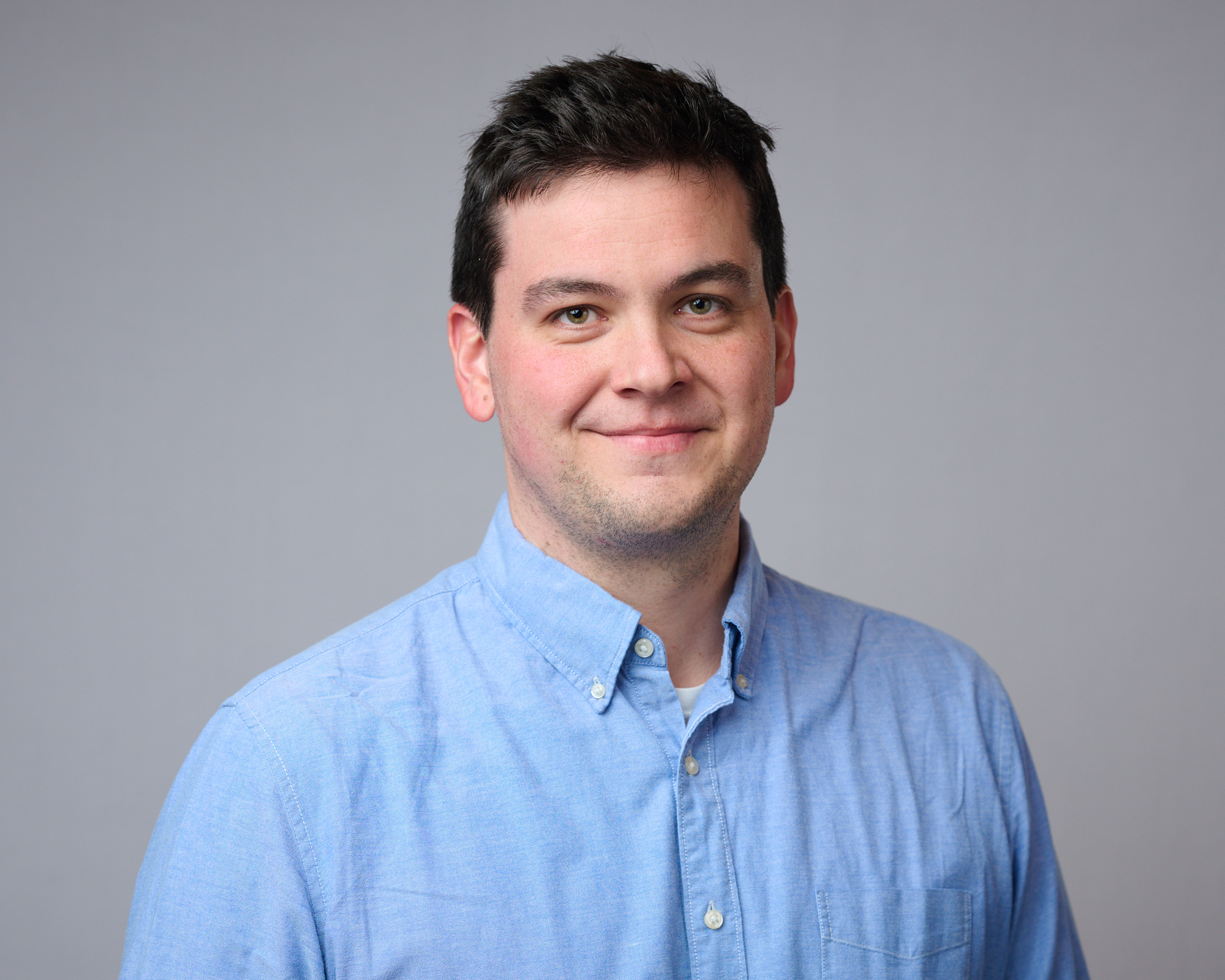
Matija Medvidović
I am a physicist and machine learning researcher working at the intersection of artificial intelligence and quantum science. My research builds differentiable, amortizable, and physically principled solvers for quantum physics and chemistry — methods where the laws of nature serve as hard structural priors rather than learned heuristics. I believe method development and scientific discovery are one and the same: better scientific AI does not merely compute faster, it enables precision at entirely new scales.
My work pursues two interconnected directions: AI-driven solvers for large-scale electronic structure, and neural quantum states as precision simulation tools for near-term quantum hardware. I completed my PhD at Columbia University and the Flatiron Institute, supported by the Simons Foundation CCQ Graduate Scholar Award.
Research
Electronic Structure
Density functional theory (DFT) has been a central pillar of computational physics, chemistry, and materials science for decades. It offers a tunable balance between accuracy and efficiency through the choice of exchange-correlation (XC) functional. The most accurate orbital-dependent XC approximations, however, produce a non-physical and non-local effective interaction, leading to systematic errors in ionization potentials, charge transfer, and long-range behavior.
Currently, I am developing variational solutions for computing optimized effective potentials (OEP) using a Gaussian multipole splat parameterization of the source density, recovering exact asymptotic boundary conditions. I have also explored neural network distillation of orbital-dependent XC functionals into accurate local models, and co-developed GradDFT, an open-source, differentiable software library for integrating machine learning with DFT. Beyond mean-field, I have shown that deep learning can build latent representations of many-body vertex functions, making correlated-phase calculations accessible without discarding any underlying physics.
Computational Quantum Physics
Neural network quantum states (NQS) have emerged as a powerful variational ansatz within quantum Monte Carlo: wavefunctions are represented as neural networks and optimized via online sampling from the quantum Born distribution. My work has expanded the reach of NQS beyond the ground state.
My work has demonstrated NQS-based simulation of real-time dynamics in continuous-variable systems and developed a variational method for computing many-body excited states in parallel. I showed that NQS can classically simulate large quantum circuits via a stochastic geometric optimization scheme, positioning NQS as a precise classical benchmark for near-term quantum hardware. I also authored a comprehensive review article on the NQS-VMC field.
Artificial Intelligence
AI methods work best in science when the laws of nature are built in as hard structural priors. The variational principle, conservation laws, and exact asymptotic constraints are often sufficient to reach solutions with far less data than data-driven approaches require. When data is available, it acts as a regularizer rather than the primary driver, flipping the script established by the broader AI community.
My AI research focuses on physics-informed machine learning: differentiable solvers for quantum science. I have worked on generative models for lattice field theories, ML-based compression of quantum many-body physics, and latent flow representations of renormalization group.